StorX
  • Storage Systems
    • Pallet Racking Systems
      • Selective Pallet Racking
      • Pushback Rack
      • Pallet Flow Racking
      • Cantilever Racking
      • Bin Shelving
      • Carton Flow and Case Flow Shelving
      • Mezzanine and Work Platforms
      • Very Narrow Aisle Racking (VNA)
      • Rivet Shelving
      • Tire Rack
      • Records Storage Shelving
      • Structural Pallet Racking
      • Used Pallet Racking
      • Double-Deep Pallet Racking
      • Drive-Through Racking
      • Wide Span Shelving
      • Stack Rack
      • Hybrid Pallet Racking
    • Wire Cages and Partitions
    • Industrial Fans
    • Rack Repair Kits
  • Automated Systems
    • Pallet Shuttles
    • Automated Storage & Retrieval Systems (ASRS)
    • Rack Supported Buildings
    • Conveyors & Automation
    • Sortation and Product Movement
    • Automated Packaging & Shipping
  • Industries
    • Cold Storage
    • Third Party Logistics
    • Retail & E-Commerce
    • Food & Beverage
    • Manufacturing & Industrial
    • Warehouse and Distribution
    • Data Centers
    • Consulting & Sourcing
  • System Services
    • System Design & Layout
    • System Integration & Implementation
    • Installation
  • About Us
    • Locations
    • Blog
  • Contact
  • Menu Menu

7 Types of Pallet Racking Explained: A Complete Guide

Choosing warehouse racking is a trade-off between density, accessibility, cost, and throughput. The right system depends on how your inventory moves, how much space you have, and what your operation needs to prioritize.

This pallet rack guide compares the main systems by how they store, present, and move inventory.
What Is Pallet Racking?

Pallet racking is an engineered, vertical warehouse storage system where upright and beam assemblies form multi-level industrial shelving configured to store palletized unit loads across elevated horizontal rows.

By storing goods vertically rather than relying on floor-level stacking, facilities dramatically increase structural volume and cubic storage density.

A warehouse racking system is not merely static steel; it is the physical foundation that governs material flow, safety, and inventory accessibility. That’s why the global warehouse-racking market is rapidly growing – estimated at $10.5 billion in 2026 and projected to reach $12.4 billion by 2030.

What Is the Most Common Type of Pallet Racking?

Today, selective pallet racking represents more than 38% of global warehouse-racking revenue, with drive-in racking standing as the second-largest segment.

Why Selective Pallet Racking Is the Most Popular System

Selective pallet racking combines flexibility, accessibility, and relatively low upfront cost. Every pallet position remains directly accessible with standard forklifts, making it well suited to operations with high SKU counts, changing inventory mixes, and pick-intensive workflows – like in ecommerce environments.

Its adaptable layout also makes it easier to reconfigure as storage needs change and to integrate with automation as the operation grows.

How Many Pallet Racking Types Are There?

Physical rack systems fall broadly into two primary categories: static selective systems and dynamic high-density rack styles, even though storage and automation solution providers offer dozens of customized sub-varieties.

In practice, there are approximately seven major types of pallet racks commonly deployed across commercial facilities.

Different Types of Warehouse Racking Systems

The different types of pallet racking styles differ in how they balance storage density, pallet accessibility, inventory rotation, equipment requirements, and picking speed. Some prioritize direct access, while others trade selectivity for greater density or faster product flow.

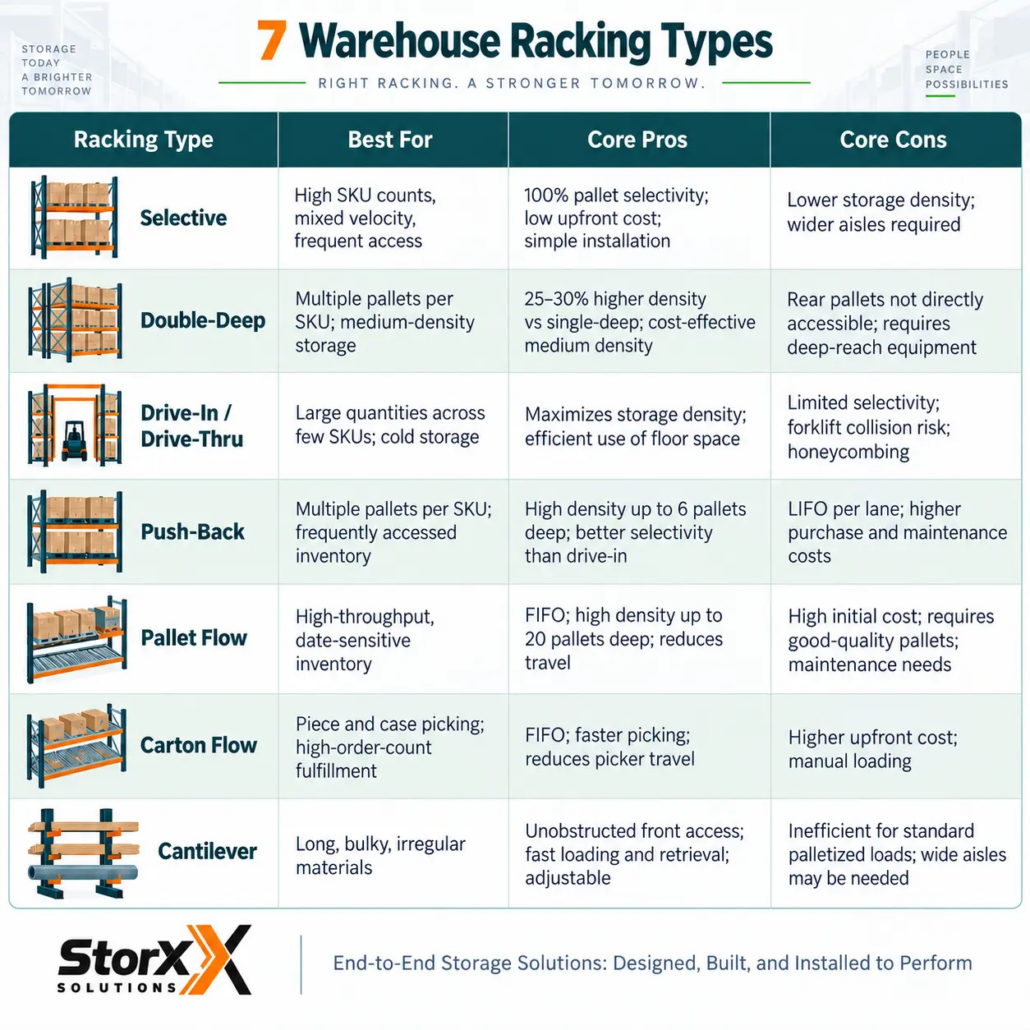
Pallet Rack Types at a Glance

Warehous Racking Types

1. Selective Pallet Racking: A Flexible Warehouse Rack Type for Direct Pallet Access

Selective racking represents the foundational framework for standard industrial distribution.

Built from vertical upright frames connected by adjustable horizontal step or box beams, it provides direct, unhindered access to every single pallet location without repositioning other pallets, giving operations strong flexibility across large and varied SKU ranges.

Pros

  • 100% pallet selectivity
  • Low capital entry cost
  • Simple installation
  • Fully compatible with standard material handling equipment
  • Well suited to mixed inventory velocities and frequent picking across the full SKU range

Cons

  • Delivers lower volumetric storage density than high-density systems such as drive-in, push-back, and pallet flow racking
  • Requires wide aisle space for forklift clearance
  • Decreases overall warehouse space utilization

Best Applications

  • High SKU counts, particularly operations with 200+ active SKUs
  • Mixed-velocity inventory
  • Operations requiring frequent access across the full inventory range
  • FMCG (Fast-Moving Consumer Goods)
  • General manufacturing
  • Retail distribution
  • FIFO (First-In, First-Out) inventory rotation
  • Warehouses where pallet accessibility takes priority over maximum storage density

2. Double-Deep Pallet Racking: A Space-Saving Rack Style for Greater Storage Density

Double-deep pallet racking is a higher-density adaptation of selective racking that stores pallets two deep, one behind the other, from each aisle face.

By increasing rack depth and reducing the number of access aisles required, facilities can store more pallets within the same floor area.

Pros

  • Increases storage density by around 25% to 30% compared with conventional single-deep racking, depending on warehouse layout and aisle width
  • Reduces the amount of floor space dedicated to aisles
  • Cost-effective option for medium-density pallet storage
  • Provides greater pallet accessibility than deeper high-density systems such as drive-in racking

Cons

  • Reduces direct pallet accessibility compared with selective racking because the rear pallet cannot be retrieved until the front pallet is removed
  • Requires deep-reach handling equipment, such as reach trucks with telescopic forks or scissor/pantograph mechanisms
  • Requires LIFO (Last-In, First-Out) inventory handling within each double-deep storage location

Best Applications

  • High-volume SKUs with multiple pallets of the same product
  • Operations with relatively low-to-moderate SKU counts and multiple pallets per SKU
  • General manufacturing
  • Commercial distribution with multiple pallet loads per SKU
  • Inventory that does not require strict FIFO rotation

3. Drive-In and Drive-Thru Racking: High-Density Racking for Deep-Lane Storage

Drive-in and drive-thru racking are high-density storage systems in which forklifts enter the rack structure to place or retrieve pallets stored several positions deep. Drive-in racking uses the same side for loading and retrieval, while drive-thru racking provides access from both ends.

Pros

  • Maximizes storage density
  • Uses warehouse floor space more efficiently
  • Well suited to large quantities of similar products or SKUs

Cons

  • Limits pallet selectivity because loads stored deeper in the lane are not immediately accessible
  • Higher risk of forklift collisions with the rack structure
  • Susceptible to inventory “honeycombing” – unusable empty pallet positions in deep racking systems
  • Requires uniform pallet sizes

Best Applications

  • High-density storage of large quantities across a limited number of SKUs
  • Low-rotation, non-perishable inventory
  • FIFO inventory rotation with drive-thru racking
  • Cold storage and freezer warehouses

4. Push-Back Racking: A High-Capacity Rack Type for Multiple Pallets per SKU

Push-back racking stores pallets on nested carts that move along inclined rails. Each new pallet pushes the previous load deeper into the lane; when the front pallet is removed, gravity moves the next pallet forward.

Pros

  • High-density storage up to six pallets deep
  • Greater pallet selectivity than drive-in racking
  • Forklifts remain outside the rack structure, reducing rack damage
  • Faster loading and unloading than comparable drive-in systems

Cons

  • Can only use LIFO rotation per lane
  • Incurs higher purchase and maintenance costs
  • Requires good-quality, consistently sized pallets

Best Applications

  • Multiple pallets per SKU
  • High-density storage requiring greater selectivity than drive-in racking
  • Frequently accessed inventory
  • Operations that do not require FIFO rotation

5. Pallet Flow Racking: Gravity-Fed Racking for FIFO Inventory Flow

Pallet flow racking, also called gravity flow racking, uses inclined roller tracks to move pallets automatically from the loading side to the picking side. Brakes control pallet speed as loads move forward by gravity.

Pros

  • High-density storage up to 20 pallets deep
  • First-In, First-Out (FIFO) inventory rotation
  • Fast inventory turnover
  • Fewer aisles required
  • Reduces travel between loading and picking

Cons

  • High initial cost
  • Requires pallets in good condition to prevent jams from broken pallet pieces
  • Involves ongoing maintenance of wheels and brakes

Best Applications

  • High-throughput distribution
  • Date-sensitive inventory (CPG, pharmaceuticals, food and beverages)

6. Carton Flow Racking Systems: A Warehouse Rack Style for Case and Piece Picking

Carton flow racking uses inclined roller or wheel tracks to move cartons from the rear loading side to the front pick face by gravity. Unlike pallet flow, which moves full pallets, carton flow is designed for cartons, cases, totes, and smaller non-palletized items.

Pros

  • First-In, First-Out (FIFO) stock rotation
  • Faster case and piece picking
  • Reduces picker travel and reaching
  • Can reduce labor costs through faster picking

Cons

  • Higher upfront cost than standard pallet racking
  • Cost varies with track width, frame height, and roller density
  • Requires manual loading of cartons onto the tracks

Best Applications

  • Piece and case picking
  • High-volume, high-order-count fulfillment
  • Small-item and parts picking

7. Cantilever Racking Systems: A Rack System for Long and Bulky Loads

Cantilever racking uses horizontal arms extending from rear upright columns, leaving the front of the rack open for storing loads that do not fit efficiently in standard pallet racking.

Pros

  • Unobstructed front access
  • Fast loading and retrieval
  • Adjustable for changing load sizes
  • Available in single- and double-sided configurations

Cons

  • Inefficient for standard palletized loads
  • Requires wide aisles for material handling equipment
  • May require specialized lift trucks
  • Can require floor or foundation reinforcement

Best Applications

  • Long, bulky, or irregular materials
  • Lumber and building materials
  • Pipes and tubing
  • Steel and metal stock
  • Furniture
  • Manufacturing and industrial storage

Specialized Warehouse Racking Systems

Beyond conventional pallet storage, specialized pallet racking systems are designed to make better use of vertical space, compact storage areas, or support more specific picking and storage requirements.

Multi-Tier / Vertical Racking

Multi-tier racking uses multiple levels connected by stairs to make greater use of vertical warehouse space for manual picking. Conveying equipment is typically used to move picked goods out of the system.

Pros

  • Maximizes vertical space for order picking
  • Direct SKU access without lift equipment
  • Accommodates different carton and item sizes

Cons

  • Higher relative cost
  • Typically requires conveying equipment

Best Applications

  • Small-item order picking
  • Auto parts and fastener distribution
  • Pharmaceutical operations

Mobile Racking

Mobile racking places storage racks or shelving on movable bases that travel along tracks. The rows can be compacted together and opened where access is needed.

Pros

  • Maximizes storage density
  • Keeps stored inventory accessible
  • Allows the layout to be reconfigured

Cons

  • High installation cost
  • Slower aisle access
  • Requires ongoing maintenance

Best Applications

  • Cold storage
  • Archival storage
  • Space-constrained facilities

Beyond Traditional Racking: Automated Storage Systems

Racking decisions can also affect the path to warehouse automation.

Some high-density storage systems integrate naturally with semi-automated technologies such as pallet shuttles, while others may require more significant reconfiguration before automation is added.

For now, automation remains the exception rather than the norm: only about 15% of warehouses are automated, while roughly 80% still operate largely manually with support from scanners, tablets, wearables, and similar technologies.

Still, even partially automated storage can change how inventory moves through the warehouse by reducing forklift travel, manual handling, and repeated retrieval tasks.

Pallet Shuttle Systems

Pallet shuttle systems use electrically powered shuttles that travel along rails within deep storage channels to move pallets. This reduces the need for forklifts to travel inside the storage lanes.

Key Benefits

  • High-density pallet storage
  • Semi-automated pallet movement
  • FIFO or LIFO configurations
  • WMS integration

Automated Storage and Retrieval Systems (AS/RS)

AS/RS use computer-controlled cranes or shuttles to store and retrieve inventory automatically within engineered racking structures. They make greater use of vertical space, reduce manual handling, and support precise inventory control in high-density facilities.

These automated systems can also integrate with warehouse management systems, conveyors, and other material handling equipment.

Choosing the Right Racking System

Most warehouses choose racking based on upfront cost or what they’ve used before. Indeed, in a recent survey, 48.6% of distribution-center respondents identified cost reduction as their primary organizational goal.

That approach, though, misses the bigger picture. A system that looks affordable at installation can add significant labor cost over a three-to-five-year period if it slows your pick cycle or limits throughput.

Before Comparing Racking Systems, Define Your Operation

Start with a few practical questions:

  • How many SKUs are you managing?
  • What is your average pallet turn rate?
  • Do you run FIFO, LIFO, or mixed inventory?
  • Is your labor model pick-intensive or forklift-dependent?
  • Are you planning to add automation in the next three to five years?

These answers help determine whether your operation should prioritize accessibility, density, inventory rotation, labor efficiency, or automation readiness.

Four Critical Factors to Evaluate

  1. Clear Height & Building Codes: Ceiling clearances, fire codes, and sprinkler layouts establish the physical boundaries for system selection.
  2. Multi-Year Labor Expenses: A lower initial purchase price can become costly if inefficient picking adds labor expense over time.
  3. Automation Transition Path: Racking choices today shape future compatibility with semi-automated tools such as pallet shuttles.
  4. Forklift Alignment: Certain layouts, such as VNA racking, require specialized material handling equipment like turret trucks or articulating forklifts.

Balancing these factors helps refine warehouse layout design, improve key warehouse KPIs, and support better warehouse space optimization.
The right system should be evaluated against your actual operation rather than a generic use case or purchase price alone.

Choosing the Right Pallet Racking Type

The best racking type depends on how your inventory moves, not on price or habit.

At StorX Solutions, we design and install the system around your actual operation, so the choice still holds up long after setup.

Choose the rack your operation would choose. Talk to our team.

Categories

  • ASRS
  • Design
  • Pallet Racking
  • Storage Systems
Storx Solutions Final Safety Orange On Black

About Us

StorX delivers turnkey storage and automation solutions by managing design, integration, and installation as one coordinated system.

What We Do

Storage Systems

Automated Systems

Industries

Locations

Storage System Services

Contact Us

7380 Spout Springs Rd
Flowery Branch, GA 30542

(678) 336-8444

[email protected]

Website by Abstrakt Marketing Group ©
  • Privacy Policy
  • Sitemap
Scroll to top Scroll to top Scroll to top

This site uses cookies. By continuing to browse the site, you are agreeing to our use of cookies.

AcceptLearn more

Cookie and Privacy Settings


How we use cookies

We may request cookies to be set on your device. We use cookies to let us know when you visit our websites, how you interact with us, to enrich your user experience, and to customize your relationship with our website.

Click on the different category headings to find out more. You can also change some of your preferences. Note that blocking some types of cookies may impact your experience on our websites and the services we are able to offer.

Essential Website Cookies

These cookies are strictly necessary to provide you with services available through our website and to use some of its features.

Because these cookies are strictly necessary to deliver the website, refusing them will have impact how our site functions. You always can block or delete cookies by changing your browser settings and force blocking all cookies on this website. But this will always prompt you to accept/refuse cookies when revisiting our site.

We fully respect if you want to refuse cookies but to avoid asking you again and again kindly allow us to store a cookie for that. You are free to opt out any time or opt in for other cookies to get a better experience. If you refuse cookies we will remove all set cookies in our domain.

We provide you with a list of stored cookies on your computer in our domain so you can check what we stored. Due to security reasons we are not able to show or modify cookies from other domains. You can check these in your browser security settings.

Other external services

We also use different external services like Google Webfonts, Google Maps, and external Video providers. Since these providers may collect personal data like your IP address we allow you to block them here. Please be aware that this might heavily reduce the functionality and appearance of our site. Changes will take effect once you reload the page.

Google Webfont Settings:

Google Map Settings:

Google reCaptcha Settings:

Vimeo and Youtube video embeds:

Accept settingsHide notification only